Before the LASIK procedure, your eyes will be anesthetized with eye drops and a speculum will be used to restrict eyelid movement. You will be instructed to fixate on a flashing red light with one eye, while the other eye is taped shut.
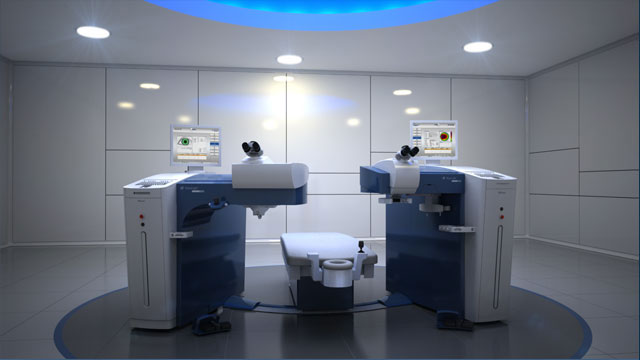
During LASIK surgery, the surgeon will use a sophisticated laser to create a thin flap. This bladeless technique is accurate and painless. Once the flap is lifted a second laser, the fastest most precise laser in North America, will be used by the surgeon to reshape the corneal surface. Lastly, the flap is then carefully repositioned and given sufficient time to adhere.
As with any surgical procedure, there are risks involved with LASIK. Although sight-threatening risks are rare – much less than 1% — we encourage you to meet with your surgeon to discuss any possible risks and complications.
An FDA study on the outcomes of Contoura® Vision LASIK eye surgery showed the following results at 1 year post procedure:
15.7% of eyes 20/10 or better
31.6% of eyes 20/12.5 or better
64.8% of eyes 20/16 or better
92.6% of eyes 20/20 or better
96.5% of eyes 20/25 or better
Apart from these excellent visual acuity results, over 30% of patients actually reported seeing better after LASIK then they had previously with glasses or contact lenses.

This is not to say that LASIK, as it’s been performed since 1996, is not a safe procedure. On the contrary, our practice has performed well over ten thousand LASIK procedures with overwhelmingly good results. Contoura® Vision Topography-Guided LASIK is expected to provide an extra measure of precision that will allow many patients who’ve been “waiting for better technology” to now feel comfortable having their vision corrected with laser eye surgery.
The diagnostic instruments used with Contoura® Vision LASIK create a map of up to 22,000 unique topographic points on each patient’s eye. This increase in data is then utilized to create an individualized treatment for each patient. The “Phorcides Analytic Engine” takes this a step further by using specialized software to analyze the unique map of each patient’s eye taken using the diagnostic instruments of the Contoura® Vision platform. This assists your surgeon in choosing the optimal treatment plan for your eyes once again leading to improved visual outcomes for our patients.
Contrary to the old myth that “the laser does all the work in LASIK”, adding the more advanced technology of Contoura® Vision and the Phorcides Analytic Engine requires even more surgical expertise and judgment than conventional laser eye surgery.
Our LASIK specialists, Dr. Martin, Dr. Adi and Dr. Flanders, invite you to make an appointment for a free evaluation of your eyes. The exam is without obligation and is offered as a free service to prospective laser surgery candidates. You can count on meeting your surgeon, being carefully evaluated, and having all of your questions and concerns addressed. We will also educate you about the latest developments in Custom LASIK surgery and let you know all of your options.
We look forward to meeting with you and evaluating whether laser eye surgery would be a good choice for you. To schedule a free LASIK consultation, please call our office at (301) 657-5700.

The LASIK procedure allows for correction of low to extreme degrees of myopia, and low to moderate degrees of hyperopia and astigmatism. Because of its many advantages, LASIK is our procedure of choice in most cases, even for lower prescriptions.
After a thorough eye examination, your eye doctor can tell you whether or not you are a good candidate for LASIK. Whether laser vision correction is right for you depends on a number of medical considerations. It also depends on you, your lifestyle and your expectations. Speaking with someone who has had laser eye surgery, as well as your eye doctor, can help you make the right decision.
Assuming your eye doctor determines that you are a good candidate for laser vision correction, the decision to have LASIK surgery is ultimately yours. Only you know what impact wearing glasses and/or contact lenses has had on the quality of your life, and only you know the value to you of reducing your dependency on these visual aids.
© 2025 Washington Eye Physicians & Surgeons
The material contained on this site is for informational purposes only and is not intended to be a substitute for professional medical advice, diagnosis, or treatment. Always seek the advice of your physician or other qualified health care provider.