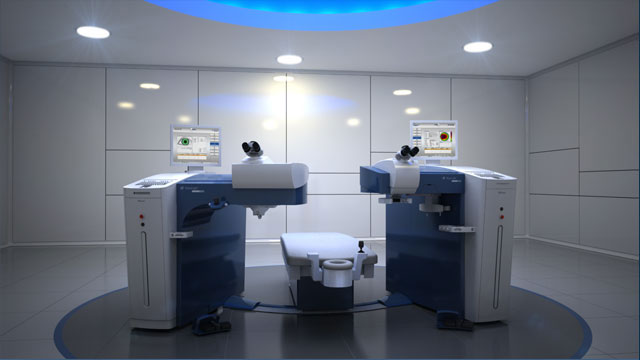
We perform Custom LASIK in the Washington DC, Virginia (VA) and Maryland (MD) area.

What is LASIK?

Laser-Assisted In-Situ Keratomileusis (LASIK) is an FDA-approved surgical procedure intended to reduce dependency on eyeglasses or contact lenses. The most commonly performed vision correction procedure, LASIK is performed on nearly 1 million patients each year to correct myopia (nearsightedness), hyperopia (farsightedness), and astigmatism by permanently altering the shape of the cornea, the eye's thin, transparent covering. Corneal reshaping increases the eye's focusing power and improves vision.

back to top

What is wavefront-guided Custom LASIK?

LASIK Surgeons Servicing Chevy Chase, Maryland office

"The LASIK Doctors at Washington Eye"

Recent media coverage of wavefront-guided Custom LASIK has drawn widespread attention to this new development in laser vision correction surgery.

Since the excimer laser was approved as safe and effective in 1995, several million Americans have had their vision corrected and have recommended LASIK to friends and family. However, concerns about nighttime glare, and reports of a very small percentage of problems have caused many people who would prefer not to wear glasses or contacts to put off having LASIK surgery. Contrary to the notion that “...the laser does all the work in LASIK,” the addition of advanced wavefront technology used in Custom LASIK requires even more surgical expertise and judgment than conventional LASIK.

Based on clinical research submitted to the FDA, most eye doctors feel that Custom LASIK will enable more people to have their vision corrected more safely than ever before. In fact, many patients who had wavefront-guided Custom LASIK found their night vision after surgery was better than their night vision with glasses or contacts before surgery.

This is not to say that LASIK, as it's been performed since 1996, is not a safe procedure. On the contrary, our practice has performed well over ten thousand LASIK procedures with overwhelmingly good results. Custom LASIK is expected to provide an extra measure of precision that will allow many patients who've been “waiting for better technology” to now feel comfortable having their vision corrected.

back to top

How does wavefront-guided Custom LASIK work?

Washington Eye LASIK recipients

"Just a few Washington Eye Staff Members who've had Vision Correction."

Conventional LASIK is based upon the patient's eyeglass prescription. Custom LASIK takes into account not just the eyeglass prescription but also subtle irregularities in the way each individual's eye focuses light. Two people can have the same eyeglass prescription, but no two people have the same wavefront map. In other words, with Custom LASIK more sophisticated measurements are used and a more precise correction is obtained. Some Custom LASIK patients even achieve better than 20/20 vision! Not all LASIK patients will benefit from custom cornea ablation. Custom LASIK is most valuable for those people with greater than average irregularities in their prescription. Only a doctor experienced in LASIK can determine the value of Custom LASIK for each individual person. Contrary to the old myth that “the laser does all the work in LASIK”, adding the more advanced technology of wavefront analysis requires even more surgical expertise and judgment than conventional LASIK. Now that Custom LASIK is a reality, many patients - who were told they could not have their vision corrected in the past because of large pupils or unusual prescriptions - may now safely reduce or eliminate their need for glasses or contacts.

back to top

Am I a Good LASIK Candidate?

Washington Eye LASIK recipients

"More Staff Members who've had Vision Correction"

The LASIK procedure allows for correction of low to extreme degrees of myopia, up to -14 diopters or greater, and low to moderate degrees of hyperopia and astigmatism, up to 6 diopters. Because of its many advantages, LASIK is our procedure of choice in most cases, even for lower prescriptions.

After a thorough eye examination, your eye doctor can tell you whether or not you are a good candidate for LASIK. Whether laser vision correction is right for you depends on a number of medical considerations. It also depends on you, your lifestyle and your expectations. Speaking with someone who has had LASIK, as well as your eye doctor, can help you make the right decision. If you would like to talk with someone who has been through the process, please call our office in Chevy Chase, Maryland, at (301) 654-5114 for a contact list of previous LASIK patients who have offered to share their experiences with you.

Assuming your eye doctor determines that you area good candidate for laser vision correction, the decision to have LASIK surgery is ultimately yours. Only you know what impact wearing glasses and/or contact lenses has had on the quality of your life, and only you know the value to you of reducing your dependency on these visual aids.

back to top

LASIK: The Procedure

Before the LASIK procedure, your eyes will be anesthetized with eye drops and a speculum will be used to restrict eyelid movement. You will be instructed to fixate on a flashing red light with one eye, while the other eye is taped shut.

During LASIK surgery, the surgeon will painlessly lift a thin, hinged flap of corneal tissue with a precise, automatic surgical instrument called a microkeratome. During these few seconds, you may feel some slight pressure, but no pain, and your vision will go dim. After the flap is folded back to reveal the cornea's midsection, called the stroma, you will be asked to look at the flashing light again, which will then be very blurry. Next, the LASIK surgeon reshapes the corneal surface by positioning the excimer laser for about 30 to 60 seconds. Lastly, the flap is repositioned and given sufficient time to self-adhere. This occurs in just a few minutes by a natural pump mechanism, without any sutures or glue. The procedure may then be repeated on the second eye.

back to top

The Risks of LASIK

Washington Eye LASIK recipients

"Yet More Staff..."

As with any surgical procedure, there are risks involved with LASIK. Side effects may include overcorrection or undercorrection, excessively dry eyes, corneal scarring, corneal edema, infection, persistent eye pain or discomfort, inability to wear contact lenses, glare and halos in the line of vision, and a decreased ability to see well at night or in fog. However, most of these subside as the healing progresses after LASIK surgery.

The chance of having a serious vision-threatening complication from LASIK is much less than 1%. To our knowledge, there have been no reported cases of blindness in the United States from LASIK.

back to top

The Benefits of LASIK

According to the Eye Surgery Education Council (ESEC), more than 90 percent of patients who undergo LASIK experience vision improved to 20/40—the minimum vision standard for driving an automobile or playing sports without corrective eyewear. Fifty-six percent of patients report post-surgery 20/20 vision. Although LASIK will not prevent age-related eye conditions or diseases, results are permanent. Most patients return to their normal daily activities one day after surgery.

The results for Custom LASIK with wavefront technology are even more impressive. Custom LASIK postoperative results are more predictable and unprecedented, with over 20% of patients achieving 20/12.5 vision or better, over 70% of patients achieving 20/16 or better and, 98% of patients achieving 20/20 or better without lenses after surgery. This result has been referred to as “super vision” — significantly better than 20/20. The incidence of postoperative complications such as glare, halos, and difficulties with night vision that occur for a small minority of LASIK patients can also be significantly reduced with wavefront technology.

back to top

What to Expect after LASIK

Washington Eye LASIK recipient

"And one More..."

Immediately after the LASIK procedure, your vision will still be quite blurry. It is common for one eye to be less comfortable than the other for the first few weeks and for one eye to see faster than the other. This is normal. It takes several weeks and often a few months for you vision to improve and stabilize. In the first week or two, most people feel as though they're looking through Vaseline, fog, or a dirty contact lens. Often they can see objects but the contrast or sharpness and clarity have not yet returned. This is completely normal. It usually takes a few weeks for this to start really coming back well and, by three months, most peoples' eyes and eye prescriptions have stabilized.

It's also common for your vision to fluctuate from moment to moment or day to day during this period. Even though your eyes don't feel particularly dry, please use the artificial tears we provided in your kit or other similar tears from the pharmacy several times a day or as needed for the next few weeks. Avoid those with preservatives and consult your post-op information sheet for the brands we recommend.

It is critically important not to rub your eyes or get hit in the eye, especially during the first few weeks after LASIK. This is similar to any surgical procedure in that one should protect the area as it heals. Most people can swim and start exercising within about a week. Check with the eye doctor who examines you after LASIK surgery to see when you can return to your normal activities. At your first and second visit after surgery your eye doctor will also tell you whether you need temporary glasses to improve your vision while your eyes are healing. This is not uncommon and generally does not suggest a problem. Red spots on the white of your eye are perfectly normal and those will usually fade over two weeks or so.

Complications after LASIK surgery by expert surgeons are uncommon. There are a few symptoms that may indicate that there may be something that needs your doctor's attention. These include: discomfort that is getting worse, rather than better in the first week or so following surgery, a significant reduction in your vision and not just a mild fluctuation, a lot of discharge or redness or swelling of your lids.

back to top

Free LASIK Consultation

Dr. Martin, Dr. Rubinfeld and Dr. Adi (our LASIK specialists) invite you to make an appointment for a free evaluation of your eyes. The exam is without obligation and is offered as a free service to prospective laser surgery candidates. You can count on meeting your surgeon, being carefully evaluated, and having all of your questions and concerns addressed. We will also educate you about the latest developments in Custom LASIK surgery and let you know all of your options.

We look forward to meeting with you and evaluating whether laser vision correction would be a good choice for you. To schedule a free LASIK consultation, please call Jennifer or Lauma at (301) 654-5114. Thank you for contacting Washington Eye Physicians & Surgeons.

back to top

Post-op Instructions

Adobe Reader may be needed to view the instructions.
If needed, it can be downloaded here.

back to top

Virtually eliminates glare and night vision problems. Allegretto Wave.

* denotes a required field


Washington Eye Physicians & Surgeons
5454 Wisconsin Ave
Suite 950
Chevy Chase, Maryland 20815

Ph. 301-654-5114
Fax .301-654-9132

Click here for map and directions (PDF)

This form is intended for general questions and eye care inquiries. It is not intended for medical advice or care. For immediate assistance or to address a medical question please call us at 301.654.5114. Please note that this is not a secure email transmission site. We are concerned with protecting your privacy as per federal HIPAA guidelines.